On Taiwan’s Frontline Islands, Troops Train for a Chinese First Strike
Penghu's Hsiung Feng missiles cover PLA routes from both directions, forcing China to neutralize the islands before any main-island invasion can begin.

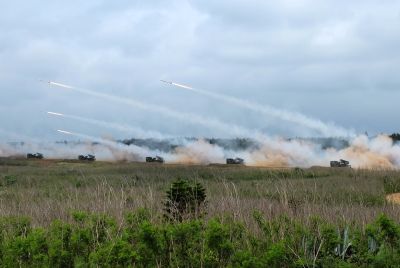
In the pre-dawn darkness on an island in the Taiwan Strait, Taiwanese troops pulled long, gleaming 105mm shells from green plastic canisters. After the ammunition had been checked and loaded through hatches on four M60A3 tanks, the soldiers waited in silence for the order to fire. The stillness broke when artillery guns nested under camouflage netting sent illumination rounds arcing out to sea, their detonations casting cold light over the ocean approaches. Then came the tanks, advancing through clouds of dust and exhaust alongside armored personnel carriers, blasting at targets representing invading forces attempting to land. As daylight crept across the water, artillery, mortars and infantry poured fire down over the sea below. Orange-red tracers from machine guns streaked into the sky.
The August 10 live-fire drill on the main island of the Penghu archipelago was one day of the annual Han Kuang exercises, Taiwan's most comprehensive war rehearsal. Reuters was granted rare access to observe it. What the reporters saw was a military preparing not for an abstract contingency but for what senior Taiwanese officials and defense analysts describe as an increasingly concrete scenario: that the People's Liberation Army will strike Penghu first, strike it hard, and that the garrison holding these islands will have to absorb that blow and hold.
Penghu is a cluster of 90 islands and islets roughly 50 kilometers off the southwest coast of Taiwan's main island — close enough to the Chinese coastline to be deeply exposed, far enough from Taipei to feel, to the islanders, like the edge of a world where decisions about war are made elsewhere. It is known as a tourist destination for its beaches and coral reefs. Its strategic significance is of a different order entirely. The islands sit at the midpoint of the Taiwan Strait. Missile batteries deployed there can engage PLA naval vessels approaching from both the east and the west simultaneously — a dual-coverage advantage that no other position in the strait provides. That geometry is precisely why China cannot bypass Penghu if it intends to move on Taiwan's main island.
"If PLA ships tried to attack Taiwan while bypassing Penghu, these ships could be struck by missiles from Penghu," Su Tzu-yun of Taiwan's Institute for National Defense and Security Research told Reuters. "That forces the PLA to attack Penghu before it can attack Taiwan." The logic is straightforward and its implications are severe: Penghu is not merely a potential battlefield. It is the battlefield that must be resolved before the larger war can begin. For the thousands of troops garrisoned there, that means their first task in any conflict would be to absorb the opening wave of a Chinese assault — and survive it long enough to matter.

On August 9, the fifth day of Han Kuang, mobile launcher vehicles armed with Hsiung Feng II and Hsiung Feng III anti-ship missiles were dispatched across the archipelago. Their crews practiced rapid deployment and tactical repositioning to verify coordination between coastal and naval elements. The Hsiung Feng III, Taiwan's most capable anti-ship missile, is supersonic and designed to penetrate modern naval defenses. Its deployment to Penghu extends Taiwan's strike reach across the strait in both directions, as Su described — and forces any PLA invasion planner to treat the elimination of those batteries as a prerequisite for the main operation. A senior Taiwanese official, speaking on condition of anonymity, told Reuters that if Penghu were taken, the entire Taiwan Strait would effectively fall into Chinese hands.
Beijing has not been silent on the subject. China's Ministry of National Defense spokesman Jiang Bin described Taiwan's fortification of the islands as "increasingly absurd and delusional." That formulation — dismissing the defensive posture as irrational rather than engaging with its strategic logic — reflects Beijing's consistent position that Taiwan's military preparations are illegitimate by definition. It also reflects the particular sensitivity of Penghu: Chinese planners are fully aware of what the islands' missile batteries mean for any invasion timeline and force structure.
The exercises were not limited to heavy weapons. During a separate drill that simulated damage to military logistics facilities, rifle-carrying troops joined civilian contractors practicing emergency repairs on military vehicles. One contractor, identified only as Ho, acknowledged that his work would make him a target during wartime. "We have a responsibility to protect our own land and our own way of life," he said. Reservists from Penghu participated in the Han Kuang exercises as part of their mandatory 14-day training program — part of Taiwan's broader effort to integrate reserve forces into operational planning and make the island's war preparations more realistic and sustainable.
Taiwan's preparations extend beyond the purely military. The island's 110,000 residents are being drawn into civil defense planning in ways that would have seemed remote a decade ago. Taipei has run programs to build civilian resilience on Penghu: stockpiling supplies, training local populations in emergency procedures, preparing for the possibility that the islands could be cut off in the event of a Chinese blockade. That scenario — a blockade rather than an assault — represents a form of coercion that stops short of direct military attack but could prove equally decisive. Locals starved of supplies might capitulate without a shot being fired. "People might think: let's surrender first, get something to eat, and after I'm full, then we'll see," said Kao Yu-jou, a 15-year-old student on the islands — a candid, unsentimental assessment of what extended isolation could produce. Taxi driver William Chen had a different answer: "If my homeland were invaded, there's no way I could just stand by."

The Han Kuang exercises this year included one unprecedented element: on August 10, Taiwan deliberately throttled mobile internet speeds in central Taiwan — centered on Taichung — for the first time during active war games, simulating communication disruption while keeping essential services including emergency calls, ATMs and traffic signals unaffected. Air-raid sirens prompted residents to clear streets from 2:30 p.m. The test signaled that Taiwan's civil defense planning has moved beyond rehearsing military responses and now encompasses the infrastructure and communications warfare that any serious conflict with China would involve from its opening hours.
The broader strategic context for the Penghu exercises is defined by one number: the PLA's sustained military buildup has not paused, moderated or reversed in pace. Beijing has not renounced the use of force against Taiwan. The United States has continued to support Taiwan's defense through arms sales and training, without making any formal commitment to intervene militarily in the event of a Chinese attack. Taiwan's defense posture is therefore built on the assumption that it must hold — alone, or nearly alone — through the opening phase of any conflict, long enough for the strategic calculus to shift. Penghu is where that opening phase would begin. The troops training in the pre-dawn darkness on those islands know it.
Whether that deterrent holds, or whether it accelerates Beijing's timeline by demonstrating that a window for relatively easier action is closing, is a question that no military exercise can answer. What the Han Kuang drills on Penghu demonstrate, with the clarity that only live fire against ocean targets can provide, is that Taiwan has chosen to answer the question the only way a smaller power can: by making the cost of the first move as high as possible, and hoping that the calculus on the other side of the strait reaches the same conclusion.
Originally published on HNGN
© {{Year}} HNGN, All rights reserved. Do not reproduce without permission.
- MOST POPULAR IN Taiwan