

Why Taiwan Chases Jensen Huang — and What Taipei Gets in Return
The Nvidia chief left Taiwan at nine and calls it his "business hometown." Its politicians are counting on an attention he generates that their diplomats cannot
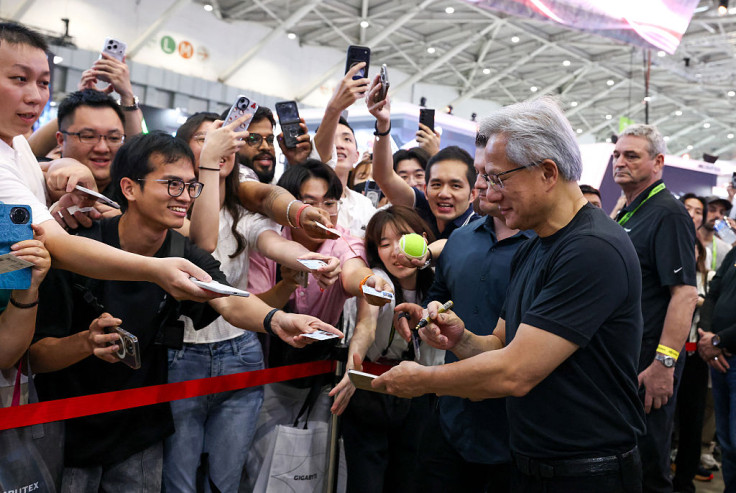
TAIPEI — Someone wrote "Jensen was here" on the tiles of a Taipei restaurant bathroom this year. A queue formed to photograph it.
The Economist, in a piece surveying what Taiwanese media call "Jensanity," reported the scene as part of an annual June phenomenon: crowds waiting outside restaurants in summer heat on rumors of a sighting, a ripple of excitement each time a black sedan passes, phones raised the moment Nvidia's chief executive steps out of a car. Security has struggled to hold the crowd on at least one occasion, when Huang arrived to dine with South Korean technology executives.
Earlier this year he appeared at the Raohe Street Night Market, ate dessert and joked with a grilled corn vendor.
The comparison the magazine draws is the useful one. Mark Zuckerberg and Sam Altman run companies of comparable consequence. Neither draws queues in the United States, and neither has merchandise printed with his face.
Part of the explanation is straightforward. Huang was born in Taiwan in 1963 and left at nine. He is now among the most successful entrepreneurs the island has produced, and he has consistently promoted its electronics industry abroad — calling Taiwan the "epicenter" of the AI revolution and describing it as his business hometown.
The financial effect is not sentimental. TSMC, Nvidia's principal manufacturing partner, has increased its market value more than fivefold since 2023 to roughly US$2 trillion, and its Taiwanese suppliers have benefited alongside it. The TAIEX has risen about 90% over the past year, making Taipei the world's fifth-largest equity market.
Nvidia-designed GPUs supply roughly two-thirds of global AI computing capacity. A word of praise from Huang can move a supplier's share price.
The part that matters beyond the stock market is harder to quantify.
Most of the world's advanced chips are made by Taiwanese firms, on an island whose sovereignty few governments formally recognize. Taiwan's politicians hope that centrality in the AI boom converts into soft power — and, as The Economist notes, that hope rests on a security calculation. Taiwan's defense depends substantially on whether other countries, principally the United States, are willing to defend it.
Huang has raised Taiwan's international visibility and made a considerable number of Taiwanese people wealthier. He does not work for Taiwan, holds no office and represents no ministry.
That is the awkward part of the arrangement. Taiwan's most effective international advocate is a private citizen of another country, whose commercial interests happen to align with Taipei's diplomatic ones — and whose lobbying is directed at his own business needs rather than Taiwan's.
Huang has pressed Washington to relax export restrictions imposed on advanced AI chips bound for China since 2022, while also engaging Chinese officials and promoting a concept of "sovereign AI" under which countries build their own infrastructure. That has drawn criticism from some US politicians. He has continued to emphasize Taiwan's importance to Nvidia and to expand its presence in Taipei.
His charisma is also, per the reporting, a supply chain asset. Taiwanese manufacturers want to work with him and expect his profile to raise their own. When AI chips are scarce, that relationship may hand Nvidia additional negotiating leverage.
Inside the company, the management style is described as demanding: little patience for excuses, direct challenges to whoever owns a problem, feedback delivered in public. Around 60 people report to him directly, far more than is typical.
It has not produced turnover. Nvidia's senior leadership has been unusually stable for two decades by technology industry standards, and many of its executives have become very rich.