

Washington Names Taiwan as a Partner on Two Palau Projects in $150 Million Pacific Package
Taiwan collaborates with the US on hospital and water projects in Palau, reinforcing its diplomatic presence in the Pacific.
TAIPEI — The US State Department has named Taiwan as a partner on two development projects in Palau, part of a package of more than US$150 million in support for Pacific island nations announced this week.
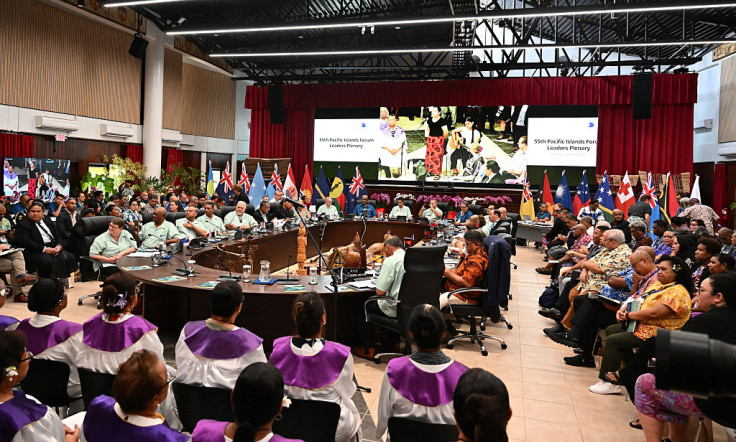
Deputy Secretary of State Christopher Landau announced the funding at the Pacific Islands Forum Partners Dialogue on Tuesday, following the opening of the 55th PIF Leaders Meeting in Palau on Sunday. The department set out the commitments in a statement titled "Promoting Pacific Prosperity: US Engagement at the Pacific Islands Forum."
The two projects involving Taiwan are the Palau Hospital Relocation project — a partnership of the United States, Taiwan, Australia, Japan, New Zealand and South Korea to develop and operate a new hospital facility — and a Drinking Water Sampling project run by the US Environmental Protection Agency with Taiwan.
The water project would help Palau sample its drinking water sources and wells comprehensively, and train drinking water operators and environmental laboratory regulators in sampling techniques, the department said.
The projects themselves are modest. The listing is not.
Being named in a State Department statement as a partner alongside Australia, Japan, South Korea and New Zealand places Taiwan in the same sentence as four US treaty allies and partners, in an official document, in an explicitly regional security context. Taiwan's diplomatic position means that form of enumeration is uncommon and carries weight beyond the dollar value attached to it.
Palau is one of a small number of states maintaining formal diplomatic relations with Taipei, and one of three in the Pacific. It has been under sustained pressure to switch recognition to Beijing.
Foreign Minister Lin Chia-lung said he welcomed continued US support for Taiwan's international participation and Washington's recognition of Taiwan's contributions to regional development, and looked forward to expanding cooperation in the Pacific and elsewhere.
Lin framed the arrangement as a convergence of approaches, describing Taiwan's "integrated diplomacy" strategy as complementary to Washington's "commercial diplomacy."
The State Department's own framing was more transactional.
US commitment to Pacific security and prosperity "is steadfast and enduring, and remains a core pillar of its 'America first' foreign policy," the statement said.
"Under President Trump and Secretary Rubio's leadership, we are prioritizing commercial diplomacy and reorienting our foreign assistance programs in the Pacific around championing US enterprise and investments in enabling infrastructure that supports private sector-led economic growth."
That is a description of aid reoriented toward commercial return, and it explains why the projects named are hospital construction and water infrastructure rather than governance or civil society programs. Both are the kind of "enabling infrastructure" the statement describes, and both create procurement opportunities.
"When the Pacific islands are stable, secure and prosperous, the United States is too," the department said.
For Taipei, participation in US-led infrastructure in a country that recognizes it serves two purposes at once: it delivers something tangible to a diplomatic ally under pressure, and it embeds Taiwan in a multilateral arrangement that Beijing cannot easily object to without objecting to the whole package.
That is the mechanism Taiwan's remaining diplomatic relationships increasingly rely on. Direct bilateral aid is straightforward for China to outbid. Participation in a six-country hospital project is harder to displace.