

Taiwan Is Growing at a 16-Year High. Nearly 80% of Its Exports Are One Product Category.
Forecasts have been revised up repeatedly, with official projections now near 9.6% and think tanks above 10%. The AI cycle has insulated Taiwan from the shock that hit every other Asian economy this year — which is the concentration risk stated another way.
While most of Asia spent 2026 absorbing an energy shock, Taiwan barely registered it.
The Taiwan Institute of Economic Research noted in its late-July research that the island's economy has remained largely shielded from the disruptions of the renewed US-Iran conflict, including oil price volatility and heightened supply chain risk, attributing that resilience to robust demand for AI, high-performance computing and cloud services.
The numbers behind that claim are difficult to overstate. Taiwan's statistics agency now expects 2026 GDP growth of 9.64%, the fastest since 2010, having revised up a February forecast of 7.71%. First-quarter growth was revised to 14.55% — the quickest quarterly pace in nearly 48 years. The economy grew 8.76% in 2025, its fastest in 15 years.
Forecasters have been competing to raise their numbers. The central bank lifted its projection to 9.45% in mid-June, more than two percentage points above its previous estimate. TIER expects 10.38%, joining Academia Sinica and the Chung-hua Institution of Economic Research in projecting double-digit expansion.
The export figures are the whole story
Trade is doing almost all of the work, and the scale is unusual even by Taiwanese standards.
The statistics agency expects 2026 exports to rise 39.77% year on year — the fastest in five decades, against a previous forecast of 22.22%. Export orders, a leading indicator, jumped to $95 billion in June, up 59% from a year earlier. Imports also hit a record $63 billion in the same month, up 51.8%.
Reciprocal tariff rates on Taiwanese goods were reduced to 15% and exempted from stacking with pre-existing most-favoured-nation tariffs, with preferential Section 232 treatment granted for automotive parts and other products — measures the agency said enhance the export competitiveness of traditional industries.
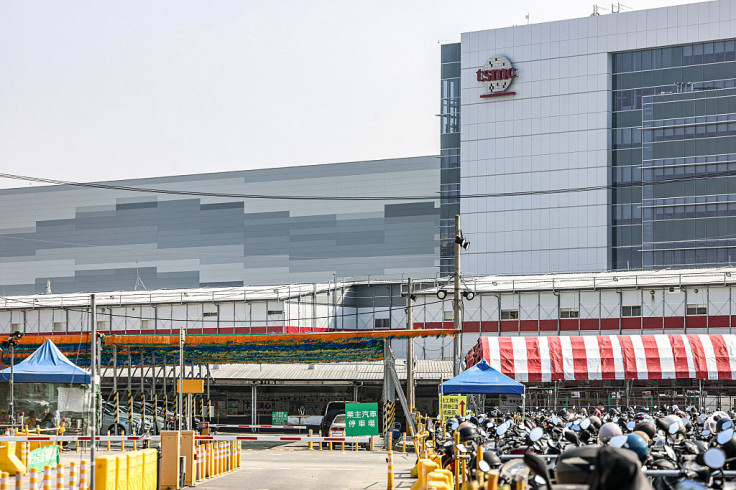
Taiwan produces more than 60% of the world's semiconductors and over 90% of the most advanced chips used in AI accelerators, according to industry estimates. TSMC has been running near full capacity and has raised its capital expenditure guidance for 2026.
The concentration is the risk
The same figures that describe the boom describe the exposure.
Semiconductors and other AI-related equipment account for around 80% of Taiwan's total exports, and the ratio of exports to GDP is roughly 76%. Consumption, by contrast, represents about 40% of output — an unusually small share for a developed economy.
That structure is why the energy shock passed Taiwan by. It is also why a downturn in AI capital expenditure would arrive undiluted. An economy where four-fifths of exports are one product category, sold largely to a handful of buyers, has no second engine.
The demand underneath it continues to scale — OpenAI's annualised revenue has roughly doubled to top $40 billion — but that is a cycle, and cycles turn.
Other structural constraints sit alongside it: low wage growth despite the expansion, economic gains concentrated in a very small number of companies, and an ageing population.
Supply chains are shifting home
One development in the trade data has received less attention than the headline growth.
A Ministry of Economic Affairs survey released at the end of June found nearly 53% of Taiwanese companies' overseas orders were produced domestically in 2025 — the highest proportion recorded. Manufacturing in ASEAN countries rose to a record 11.3%, while production in China and Hong Kong continued to fall.
Taiwanese firms are moving production out of China, and a substantial share is coming back to Taiwan rather than relocating to Southeast Asia.
What to watch
August export data, due in September, is the near-term test of whether the pace is holding.
The second is third-quarter GDP, which the Directorate-General of Budget, Accounting and Statistics will release in late November. Second-quarter growth came in at 12.9%.
The third is the risk nobody can model. Cross-strait tensions and potential export controls remain the principal threats to a supply chain the entire AI industry depends on.