

Taiwan’s 40°C Heat Drill Was Held in Pouring Rain. Officials Said That Was Useful.
Paramedics ran through downpours to treat mock heatstroke patients in New Taipei City. A climate official said a heat drill turning into a flood drill is exactly what Taiwan should expect
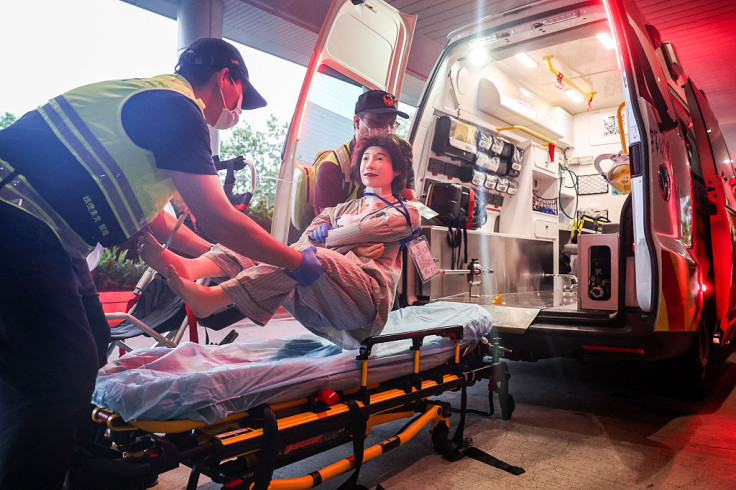
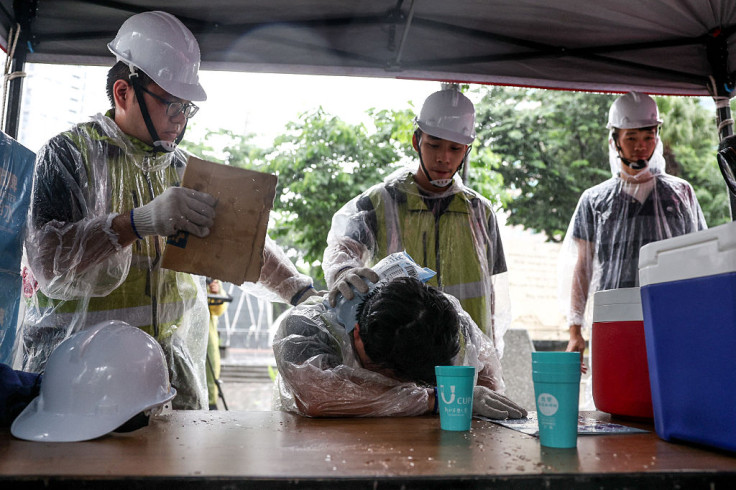
NEW TAIPEI CITY — Officials handed out raincoats and umbrellas at Taiwan's extreme heat drill on Thursday, set up gazebos against the downpour, and pressed on with simulations built around three consecutive days of 40°C temperatures.
The temperature topped out at 29°C. About 44 millimeters of rain fell over three hours in the area where the exercises were held.
In one scenario, a man playing a homeless person suffering heatstroke lay on the wet ground as two paramedics ran through the rain toward him.
Roughly 300 people from the labor, fire, social welfare and medical sectors took part, alongside 30 central government agencies, 16 New Taipei City bureaus and departments, three companies and a medical facility.
The weather was not treated as an embarrassment.
Chang Ken-mu, deputy director-general of the environment ministry's Climate Change Administration, called the rain a test of the response system's ability to adapt.
"In the future... we could have extreme heat in the morning and intense rainfall in the afternoon, turning a heat drill into a flood drill," Chang said. "This is very likely to happen in Taiwan."
That is a substantive point rather than a save. Compound weather events — where heat and heavy precipitation arrive in close succession — strain emergency systems differently from either hazard alone, because the same personnel and equipment must switch response modes within hours.
"We knew it was going to rain today," Chang said. "The point is... under any conditions, we have to be able to operate."
The exercise had already been postponed once, from last week, because of a typhoon.
Taiwan has been building out heat preparedness for two years, and the case for it is demographic as much as meteorological.
Heat injuries among older people reached 791 in 2024, two and a half times the level of a decade earlier, with annual hospital treatment costs of about NT$28 million, according to environment ministry figures. Taiwan is now a super-aged society, with people 65 and over accounting for more than a fifth of the population — and its own projections put that share above half by 2075.
Its average temperature rose 1.6°C between 1911 and 2020.
The government held a nationwide multiagency exercise in late June simulating a three-day 40°C heatwave across Taipei, New Taipei and Taoyuan, involving 34 agencies. That drill tested cascading failures: substation outages, hospitals switching to backup power, surging emergency admissions, railway speed restrictions and road deformation.
Officials noted then that extreme heat generates systemic risks despite not being classified as a disaster under Taiwanese law.
Adaptation measures now include 5,767 cooling stations nationwide and an AI-driven system that forecasts dangerous indoor temperatures for older people living alone three to six hours ahead.
Urban form compounds the problem. The Taipei basin's dense development has produced city-center temperatures more than 3°C above surrounding areas, and researchers have found that parts of the region are warming faster at night than during the day — depriving the body of the recovery period that makes daytime heat survivable.
New Taipei City temperatures have frequently reached the high 30s during recent summers.
Thursday's 29°C was, by the Central Weather Administration's assessment, unremarkable. So was the rain. Forecaster Wang Pin-hsiang told AFP that 44 millimeters over three hours "isn't really considered particularly heavy rainfall."
Which is arguably the more useful finding. The system was tested by an ordinary day.